Cours de tokharien 21-22 mai 2026 - 19h30-21h (heure de Paris)
Dans le cadre de l'Universitas Linguarum, le Professeur António de Freitas animera deux séances d'initiation au tokharien, langue indoeuropéenne qui fut parlée au Xinjiang en Chine. Ces leçons auront lieu les 21 et 22 mai prochains de 18h30 à 20h. Un lien zoom sera publié sur le site de la Societas Anatolica : www.societasanatolica.org/universitas
UNIVERSITAS
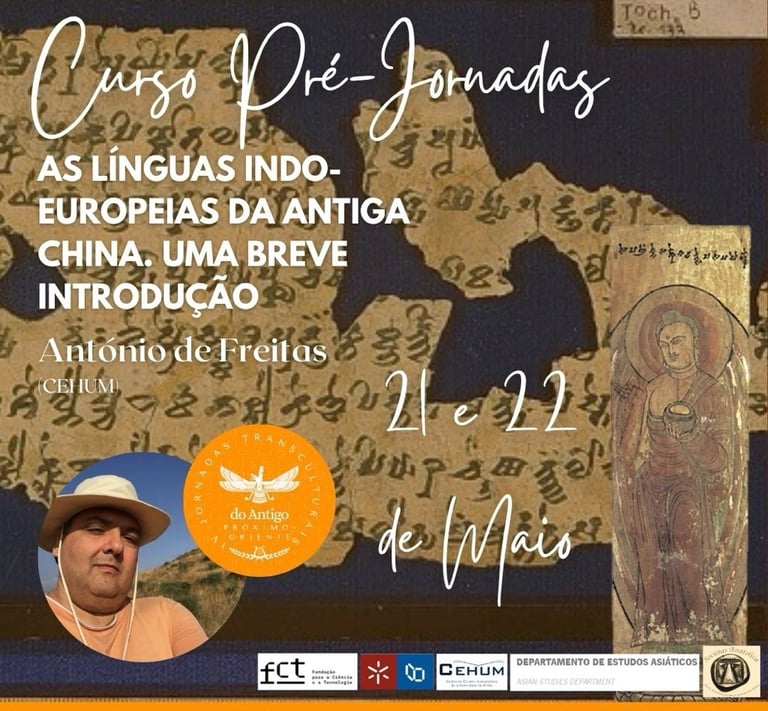
Around 4500 BC, Proto-Anatolian, a language that would give rise to several languages spoken in Anatolia during the 2nd and 1st millennia BC, split off from Indo-European. Its main representative is Hittite. These languages were sisters of Latin, Greek, Vedic, and many others that gave rise to most languages spoken in Europe today.
About a millennium later, around 3500 BC, a second branch of Indo-European, Proto-Tocharian, split off. Its speakers migrated eastward to the Tarim Basin and neighboring regions. Between the 1st millennium BC and the 1st millennium AD, we have written records in these languages. Being sisters of Latin, Greek, Hittite, and Vedic, these languages adopted the ancient Brahmi script as the basis for their writing. Known as Tocharian A and Tocharian B, they ceased to be used with the expansion of China and the conquest of these lands.
This mini-course offers a brief introduction to the most eastern known Indo-European languages.
Mentions légales :
Societas Anatolica, société savante assumant l'héritage spirituel de la Société des études hittites et asianiques, fondée le 14 novembre 2003 par le Professeur René Lebrun, placée sous le haut patronage de l'Institut Catholique de Paris et de l'Institutum Turcicum Scientiae Antiquitatis d'Istanbul.
Siège social : Institut Catholique de Paris, 21, rue d'Assas 75006 Paris
Siret : 924 665 672 00011C
RNA : W751162446
Responsable de publication : Eric Raimond, président de la Societas Anatolica, 18, place de la République, 91400 Saclay
Collecte des données personnelles via le formulaire de contact : accessible au Responsable de publication afin de répondre aux messages et conservées pendant une durée de 6 mois.
Vous pouvez exercer vos droits d'accès, de rectification et de suppression auprès de :
ericraimond@societasanatolica.org
Création du site :
Hébergeur : Hostinger International Ltd.
61 Lordou Vironos Street, 6023 Larnaca, Chypre
Site : https://www.hostinger.fr

