
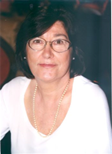
Marie-Claude Trémouille
Fonctions au sein de la Societas Anatolica
Ancien membre du Conseil scientifique et du bureau
Membre actif
Parcours académique
1995 : Dottorato di ricerca in Scienze Filologiche e Storiche dell’Antichità: Civiltà Egee ed Anatoliche conseguito il 23.10.1995 con giudizio: Ottimo.
Institutions scientifiques
2009 – 2012 : Directrice de l'Istituto di studi sulle Civiltà dell’Egeo e del Vicino Oriente del CNR, Rome.
2005 - 2012 : Responsable de la commission PC.P01.003 “Civiltà dell’Anatolia e del Vicino Oriente dal III al I millennio a. C.(unità operativa CNR comprendente 2 Primi ricercatori, 3 Ricercatori, 2 Associati, 1 Assegnistica di ricerca).
Depuis 2001 : premier chercheur auprès de l’Istituto di studi sulle Civiltà dell’Egeo e del Vicino Oriente (ICEVO) del CNR, Roma.
1992-2001 : chercheur auprès de l’ISMEO (CNR), Roma
Responsabilità di Strutture:
2009-2012 : directrice de l'ICEVO.
Responsable de la commission PC.P01.003 du département du patrimoine culturel du CNR
Responsable de projet scientifique
Projet Kizzuwatna: recherche sur une région de l'empire hittite à l'âge du Bronze.
Autres activités
Depuis 2004 : directeur du comité scientifique de Res Antiquae, Bruxelles.
1997 – 2010 : secrétaire de rédaction de Studi Micenei ed Egeo-Anatolici (SMEA), Roma.
Bibliographie
1990
Il MS.429 OVIDII METAMORPH. LIBRI VI della Biblioteca di Arezzo, Atti e Memorie dell'Accademia Petrarca di Lettere, Arti e Scienze, Nuova Serie, Vol. 52, 447-449.
1991
Il tabri e i suoi addetti nella documentazione ittita, EOTHEN 4, Firenze, 77-105.
1994
a) A proposito di un rituale kizzuwatneo, in Orientis Antiqui Miscellanea, Vol. I, 93-97.
b) L'iconographie de la déesse Hebat à la lumière des textes, SMEA 34, 87-105 (+ 3 Pl.).
1995
Note sur le terme hurtišši dans les textes de Boghazköy, Atti del II Convegno Internazionale di Hittitologia, Pavia 28 Giugno - 2 Luglio 1993, Pavia, 369-380.
1996
a) Une fête du mois pour Teššub et Hebat, SMEA 37, 79-104.
b) Un objet cultuel: le šehelliški, SMEA 38, 73-94.
c) Répertoire onomastique, disponibile su Internet:http://www.bu.edu/asor/HITTITE/ HittiteHP.html.
1997
a) Remarques sur Gürün A et B, SMEA 39/2, 270-273.
b) dHebat. Une divinité syro-anatolienne, EOTHEN 7, Firenze.
1998
a) Les souverains de Hattuša curatores aquarum, Studi e Testi I (EOTHEN 9) a cura di Stefano de Martino e Fiorella Imparati, Firenze, 183-199.
b) CTH 628: une mise à jour, SMEA 40/2, 263-270.
1999
a) Quelques observations sur KBo 23.27 + et ses relations avec CTH 776, Studi e Testi II (EOTHEN 10) a cura di Stefano de Martino e Fiorella Imparati, Firenze, 193-211.
b) CTH 628: une mise à jour II, SMEA 41/1, 115-121.
c) La religion des Hourrites: état actuel de nos connaissances, Proceedings of the XLV Rencontre Assyriologique Internationale, University of Harvard, Cambridge Mass., July 5-8 1998, SCCNH 10, 267-281.
2000
a) CTH 628: une mise à jour III, SMEA 42/1, 125-132.
b) Les rituels magiques hittites. aspects formels et techniques, in La magie, Actes du Colloque International de Montpellier 25-27 Mars 1999, organisé par le Séminaire d’Étude des Mentalités Antiques (SEMA) et le Centre d’Études et de Recherches sur les Civilisations Antiques de la Méditerranée (CERCAM), Montpellier. Publications de l’Université Paul Valéry, 4 tomes. Etudes rassermblées par A. Moreau - J.Cl Turpin (eds.). Tome 1. Du monde babylonien au monde hellénistique, 77-94.
c) La religione dei Hurriti, La civiltà dei Hurriti, La Parola del Passato 55, 114-170.
2001
a) Kizzuwatna, terre de frontière, La Cilicie : espaces et pouvoirs locaux (2ème millénaire av. J.C. - 4ème siècle ap. J.C.), Actes de la Table ronde internationale d'Istanbul (2-5 Novembre 1999), Eric Jean, Ali Dinçol et Serra Durugönul (eds.), Varia Anatolica XIII, Paris-Istanbul, 57-78.
b) Les fêtes de Hanhana et Kašha: un fragment inédit, Kulturgeschichten. Altorientalische Studien für Volkert Haas zum 65. Geburtstag, Thomas Richter, Doris Prechel, Jörg Klinger (eds.), Saarbrucker Druckerei und Verlag, Saarbruck, 377-381 (con Mirjo Salvini).
c) Recensione a: S. Košak, Konkordanz der Keilschrifttafeln III/1. Die Texte der Grabung 1933: 1/c - 1300/c (StBoT 42), Wiesbaden 1998, Wiener Zeitschrift für die Kunde des Morgenlandes 91, 433-438.
2002
a) Une cérémonie pour Huwaššanna à Kuliwišna, Silva Anatolica. Anatolian Studies Presented to Maciej Popko on the Occasion of His 65th Birthday, Piotr. Taracha (ed.), Warsaw, 355-374.
b) Répertoire onomastique (Hethitisches Onomastikon), nuova versione elettronica disponibile sul sito Hethitologie Portal Mainz (www.orient.uni-wuerzburg.de).
c) CTH 479.3: rituel du Kizzuwatna ou fête à Šapinuwa?, in Anatolia Antica. Studi in memoria di Fiorella Imparati, Tomo II, S. de Martino - F. Pecchioli Daddi (eds.), EOTHEN 11, Firenze, 841-856.
d) hittite hutanu, hourrite hiriti, akkadien Hiritum, SMEA 44/1, 145-149.
2003
Les textes hittites de Meskéné/Emar, SMEA 45/2, 223-269 (con Mirjo Salvini).
2004
a) CTH 479.3: un nouveau fragment, šarnikzel. Hethitologische Studien zum Gedenken an Emil Orgetorix Forrer (19.02.1894 – 10.01.1986), Detlev Groddek - Sylvester Rößle (Hrsg.), Dresden, 645-654.
b) Un rituel de la reine pour plusieurs DINGIR.MAḪ, Varia Anatolica René Lebrun oblata, M. Mazoyer, O. Casabonne (éd.), Cahiers KUBABA, Série Antiquité V, L’Harmattan, Paris, 337-348.
c) I rituali magici ittiti, Res Antiquae 1, Bruxelles. 161-206.
d) I testi ittiti di medicina, Res Antiquae 1, Bruxelles, 207-227.
e) Pendigalli, voce del Reallexikon der Assyriologie und Vorderasiatischen Archäologie, Bd. X, 386.
f) Pentaruḫši, voce del Reallexikon der Assyriologie und Vorderasiatischen Archäologie, Bd. X, 387.
g) Kizzuwatna, A land of Exchanges, in Atti del Workshop Mersin Region Steeped in Ancient History and Culture, EU Mosaic Programme, Mersin, 25-26.
2005
Texte verschiedenen Inhalts, Corpus der hurritischen Sprachdenkmäler, Band 8 (ChS I/8), Roma. © 2005 – Istituto di studi sulle Civiltà dell’Egeo e del Vicino Oriente del CNR, Roma.
2006
a) Un exemple de continuité en Anatolie. Le dieu Šarrumma, in Pluralismus und Wandel in den Religionen im vorhellenistischen Anatolien. Akten des religionsgeschichtlichen Symposiums in Bonn (19.-20. Mai 2005), Manfred Hutter / Sylvia Hutter-Braunsar (Hrsg.), Münster, 191-224.
b) Nouvelles attestations de la reine hittite Šatanduheba, N.A.B.U. 2006/1, 26-27.
c) Répertoire onomastique (Hethitisches Onomastikon), nuova versione disponibile sul sito Hethitologie Portal Mainz (www.hethiter.net).
2007
a) Notes sur le fragment à caractère historique KUB 31.45, in Tabularia Hethaeorum, Hethitologische Beiträge Silvin Košak zum 65. Geburtstag, Detlev Groddek - Marina Zorman (Hrsg.), Wiesbaden, 681-692.
b) Nouveaux matériaux pour le Corpus der hurritischen Sprachdenkmäler, Festschrift Ilse Wegner, AoF 34/1, Berlin, 116-125.
c) Poster « Il progetto e-ChS », 53ème RAI, Moscou - Saint Petersbourg, 2007.
2008
a) La religione dei Khurriti, in Il politeismo vicino-orientale (a cura di Maria Giovanna Biga e A.Maria Gloria Capomacchia), Poligrafico e Zecca dello Stato, Roma, 279-314.
b) I regni neo-hittiti, in Il politeismo vicino-orientale (a cura di Maria Giovanna Biga e A.Maria Gloria Capomacchia), Poligrafico e Zecca dello Stato, Roma, 369-371.
c) Recensione di Storia d’Europa e del Mediterraneo. Il Mondo Antico. I. La Preistoria dell’uomo. L’Oriente Mediterraneo. A cura di Stefano de Martino. Volume I. Dalla Preistoria alla Storia, Volume II. Le Civiltà dell’Oriente Mediterraneo, Roma 2006 [2008], SMEA 48, 312-317 (co-autore con Lucia Alberti).
d) Voce “Šamri”, in Reallexikon der Assyriologie und Vorderasiatischen Archäologie, Band XI, Berlin – New York, 628-629.
2009
a) Texte aus dem Bezirk des Großen Tempels, III, serie Keilschrifttexte aus Boghazköy 51, Berlin.
b) Voce “Šarrum(m)a”; in Reallexikon der Assyriologie und Vorderasiatischen Archäologie, Band XII, Berlin – New York, 80-83.
c) Voce “Šauška, Šawuška”, in Reallexikon der Assyriologie und Vorderasiatischen Archäologie, Band XII, Berlin – New York, 99-103.
2011
Répertoire onomastique (Hethitisches Onomastikon), nuova versione disponibile sul sito Hethitologie Portal Mainz (www.hethiter.net).
2012
a) Voce “šurinni”, in Reallexikon der Assyriologie und Vorderasiatischen Archäologie, Band XIII, Berlin – New York, 403.
b) Voce “šurzi”, in Reallexikon der Assyriologie und Vorderasiatischen Archäologie, Band XIII, Berlin – New York, 438-9.
c) Voce “Šušumahi”, in Reallexikon der Assyriologie und Vorderasiatischen Archäologie, Band XIII, Berlin – New York, 479-80.
d) Voce “Šuwala”, in Reallexikon der Assyriologie und Vorderasiatischen Archäologie, Band XIII, Berlin – New York, 504.
2013
a) Voce “Tašmišu”, in Reallexikon der Assyriologie und Vorderasiatischen Archäologie, Band XIII, Berlin – New York, 475-76.
b) Voce “Ti(ja/e)banti/Tijapinti”, in Reallexikon der Assyriologie und Vorderasiatischen Archäologie, Band XIV, Berlin – New York, 32.
c) Voce “T/Dunta”, in Reallexikon der Assyriologie und Vorderasiatischen Archäologie, Band XIV, Berlin – New York, 190.
d) Remarques sur Comana de Cappadoce et sa déesse, in Ritual, Religion and Reason. Studies in the Ancient World in Honour of Paolo Xella, S. Ribichini et al. Edds, AOAT 404, Münster, 407-416.
2014
Répertoire onomastique, version 2014
2016
Texte aus dem Bezirk des Großen Tempels, XV, serie Keilschrifttexte aus Boghazköy 65, Berlin.
2018
Voce Teshub in The Encyclopedia of Ancient History. Edited by Roger S.Bagnall, Kai Brodersen,Craige B. Champion, Andrew Erskine,and David Hollander, John Wiley & Sons, Ltd.
2019
a) šuḫḫaz katta mauš(š)- ‘cadere dal tetto‘ oppure ‘gettarsi dal tetto‘, in And I knew twelve Langues. A Tribute to Massimo Poetto on the Occasion of his 70th Birrtday, N. Bolatti Guzzo and P. Taracha edds, Warsaw, 687-689.
b) A new Fragment of an Inscription of Rusa, Son of Argišti, from the susi Temple of Bastam, Iran (with Roberto Dan and al.) in Over the Mountains and Far away, Studies in Near Eastern History and Archaology presented to Mirjo Salvini on the Occasion of his 80th Birthday, P.S. Avetisyan and al. edds, Oxford, 501-510.
c) Between Philology and Archaeology. Some Remarks on Urartian Landscape Management (with Roberto Dan), in Between Syria and The Highlands, Studies in Honor of Giorgio Bucellati & Marilyn Kelly-Buccellati, S. Valentini – G. Guarducci edds., SANEM 3, Roma, 378-387.
2020
The Geography of Bia/Urarṭu, in Roberto Dan, A Study of the Toponyms of the Kingdom of Bia/Urarṭu, Roma, ISMEO.
2021
Grave 12 at Chalow: The Burial of a Lady of the “Greater Khorasan Civilization”, (with Ali Vahdati, R. Biscione, R. Dan), Journal of Iranian National Museum Vol. 1.1, 45-64.
2022
a)From Plains to Mountains: Literary and Cultural Models Between Mesopotamia and Urartu (with Roberto Dan), in The Historical and Cultural Memory of the Babylonian World. Collecting fragments of the Centre of the World, M. Ramazzotti ed., ARATTA II, 85-101.
b) Is Bastam Fortress Rusai URU.TUR? A Recently Discovered Urartian Inscription in the Area of Bastam, Iran,(con R. Dan et al.) in Dan, R., Francia, R., Trémouille, M.C. (eds.), Studia Hethitica, Hurritica et Urartaica 1, 231-248.
c) Some Remarks on Changes in the Water Level of Lake Van, Turkey: an Evaluation of the Cartographical and Archaeological Evidence (con R. Dan), East & West N.S. 3 (62) – NO. 1, JUNE 2022, 71-95.
2023
a) Il viaggio a Van di Friedrich Eduard Schulz e la scoperta di Urartu (con R. Dan), in De Caprio, F., Filippone, E., Pifferi, S. (eds.), Raccontare i luoghi e la vita degli altri. Viaggiatori e viaggiatrici per le strade del mondo, Viterbo, 109-127.
b) ISMEO Activities 2023. Lexicographic Projects. Urartian Italian (Dan, R., Bonfanti, A.S., Trémouille, M.C.), East & West N.S. 4 (63), No. 2, 231.
c) Alcune osservazioni sul rituale ittita CTH 442, in By God’s Grace: Ancient Anatolian Studies presented to Aram Kosyan on the Occasion of his 65th Birthday, Y.H. Grekyan (ed.), 361-366.
d) Avant-propos: quelques réflexions sur les exodes de divinités et leurs statues dans l’Anatolie hittite, Res Antiquae XX, 3-8.
e) Cattle for the Gods. Some remarks on evidence concerning pastoralism in the kingdom of Bia/Urartu (con Roberto Dan, Andrea Cesaretti e Annarita S. Bonfanti, VRBS, Studi sulla romanità antica e tardoantica, Roma 2023/ II.
2024
a) An Unpublished Urartian Inscription from Aznavurtepe Fortress and Some Reflections on the Question of the Alarodians (con R. Dan), in Bolatti Guzzo, N., Francia, R. (eds.), Between Philology and Archaeology Studies on Ancient Anatolia and the Near East Offered to Massimiliano Marazzi, Columbus, GA, 275-283.
b) From Ṭušpa to Apuni. An analysis of 8th century military campaigns at the northern border of Bia/Urartu (con R. Dan), in Ramazzotti, M. (ed.), Costeggiando l’Eurasia/Coasting Eurasia.
Primo congresso di Archeologia del paesaggio e Geografia storica del Vicino Oriente antico Sapienza Università di Roma, 5-8 Ottobre 2021, Atlante del Vicino Oriente antico, Opere collettanee 3, Roma, 251-263.
c) Un banquet délibératif dans KBo 32.13?, Res Antiquae XXI (Mélanges présentés au professeur René Lebrun, fondateur de la revue), 347-352.
d) Archivi scomparsi in Urartu?, in Dal segno alla parola: lingue e decifrazioni dalle antiche scritture ad oggi E. Gargano ed., Milano, 217-226 .
f) Alcuni aspetti della religione nel regno di Bia/Urartu (con Roberto Dan), in VRBS, Studi sulla romanità antica e tardoantica, Roma 2024/I, 7-42.
2025
a) The Missing Corner: An unpublished Inscription from the Körzüt Temple in Its Architectural Context (con Roberto Dan), in N. Bolatti Guzzo, M. Kapełuś, A. Kryszeń (a cura di), Ḫattušaš utnē išḫameški. Hittite and Other Ancient Near Eastern Studies Presented to Piotr Taracha on the Occasion of His 65th Birthday, Warsaw, Agade, 43–64., 2025.
Mentions légales :
Societas Anatolica, société savante assumant l'héritage spirituel de la Société des études hittites et asianiques, fondée le 14 novembre 2003 par le Professeur René Lebrun, placée sous le haut patronage de l'Institut Catholique de Paris et de l'Institutum Turcicum Scientiae Antiquitatis d'Istanbul.
Siège social : Institut Catholique de Paris, 21, rue d'Assas 75006 Paris
Siret : 924 665 672 00011C
RNA : W751162446
Responsable de publication : Eric Raimond, président de la Societas Anatolica, 18, place de la République, 91400 Saclay
Collecte des données personnelles via le formulaire de contact : accessible au Responsable de publication afin de répondre aux messages et conservées pendant une durée de 6 mois.
Vous pouvez exercer vos droits d'accès, de rectification et de suppression auprès de :
ericraimond@societasanatolica.org
Création du site :
Hébergeur : Hostinger International Ltd.
61 Lordou Vironos Street, 6023 Larnaca, Chypre
Site : https://www.hostinger.fr

